



Contents · 9 sections
- 01How is a choice built during adolescence?
- 02Why other people’s opinions matter so much at this age
- 03Friends have influence. But not always in the wrong direction.
- 04Family: a reference point, a support and a source of pressure
- 05School also shapes how young people see themselves
- 06Social media has added a new sphere of influence
- 07And in the DRC, what do we actually know?
- 08What the research allows us to say
- 09What this means for adults who support teenagers
A teenager may be convinced that they chose alone. Yet behind a seemingly personal decision there are often several voices: those of parents, friends, school, the neighbourhood and, today, social media.
A few simple questions are enough to see it. Why do some young people want to do the same job as one of their parents? Why might a course of study be rejected because it is seen as “for girls” or “for boys”? Why might a teenager make a different decision when alone than when surrounded by friends?
These situations point to a reality that developmental psychology has studied closely: a choice is never built entirely outside the social environment of the person making it. For adolescents, this matters all the more because this is precisely the stage at which they demand more autonomy while remaining highly sensitive to how those around them see them and react to them.
How is a choice built during adolescence?
Adolescence is often presented as a period of opposition or risk-taking. That reading is too narrow. Above all, it is a period of transition during which young people gradually learn to decide for themselves: who to spend time with, how to use their money, how to dress, which activities to take up, which studies to pursue or which values to adopt.
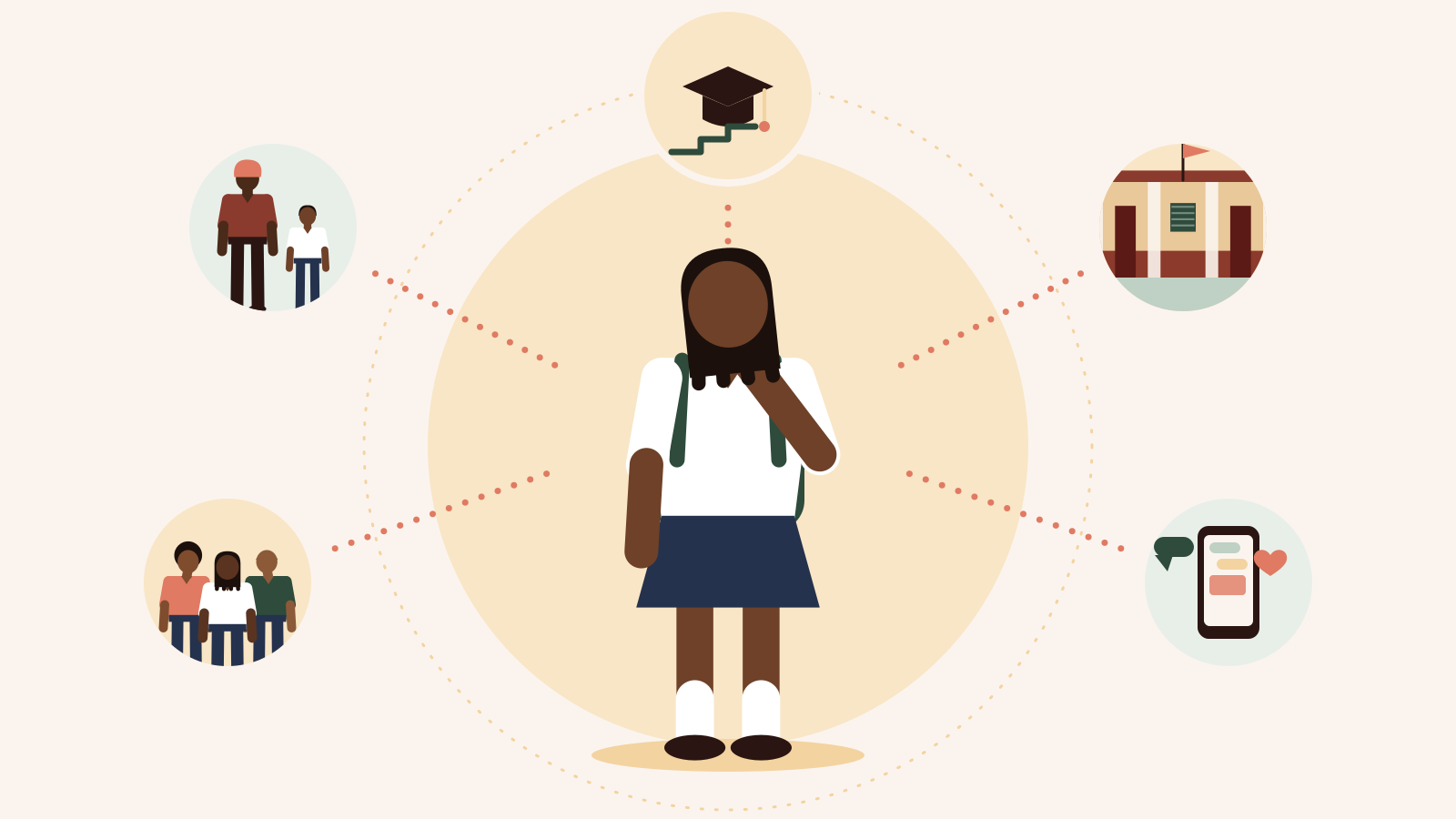
Autonomy does not arrive all at once. It is built step by step, through experiences and responsibilities. This is precisely what Urie Bronfenbrenner’s ecological approach helps us understand. In his 1979 book, the psychologist shows that the development of a child or adolescent depends on the settings in which they live and on the interactions that take place there. Family, school, peers and the community are therefore not mere background: they play a direct part in shaping perceptions, behaviours and choices.
A teenager never faces a decision with a completely blank page. They arrive with what they have been taught, what they have observed, what is valued around them, what they fear, what they hope to gain and the image they want to give others.
Why other people’s opinions matter so much at this age
Teenagers are not incapable of reasoning. Several studies show that, when the situation is calm, they can assess information about risk with abilities fairly close to those of adults. What changes more is the context in which the decision is made: the presence of peers, emotion, immediate reward, the desire to be accepted.
This is what Margo Gardner and Laurence Steinberg studied. In an experiment involving 306 people divided into adolescents aged 13 to 16, young people aged 18 to 22 and adults aged 24 and over, participants performed decision-making tasks either alone or in the presence of two people of the same age. The young participants took more risks in a group than they did alone, and this social effect was markedly stronger among adolescents and young people than among adults.
A later review by Dustin Albert, Jason Chein and Laurence Steinberg specifies the size of this effect in a simulated driving task: among young adolescents, the risky driving index was about twice as high when peers were present as when they performed the task alone. Among older adolescents, it was about 50% higher. Among adults, the presence of peers did not produce the same difference.
These results do not mean that a friend automatically doubles the risk of every decision a teenager makes. They do show, however, that the same person can judge a situation differently once the eyes of their peers come into play.
“If my friends are with me, I’d do it. Alone, I wouldn’t. It’s not fun.”
A teenager’s words reported by Cynthia Lightfoot (1997), quoted by Albert, Chein and Steinberg (2013). Wording translated from the French version of this article.
Friends have influence. But not always in the wrong direction.
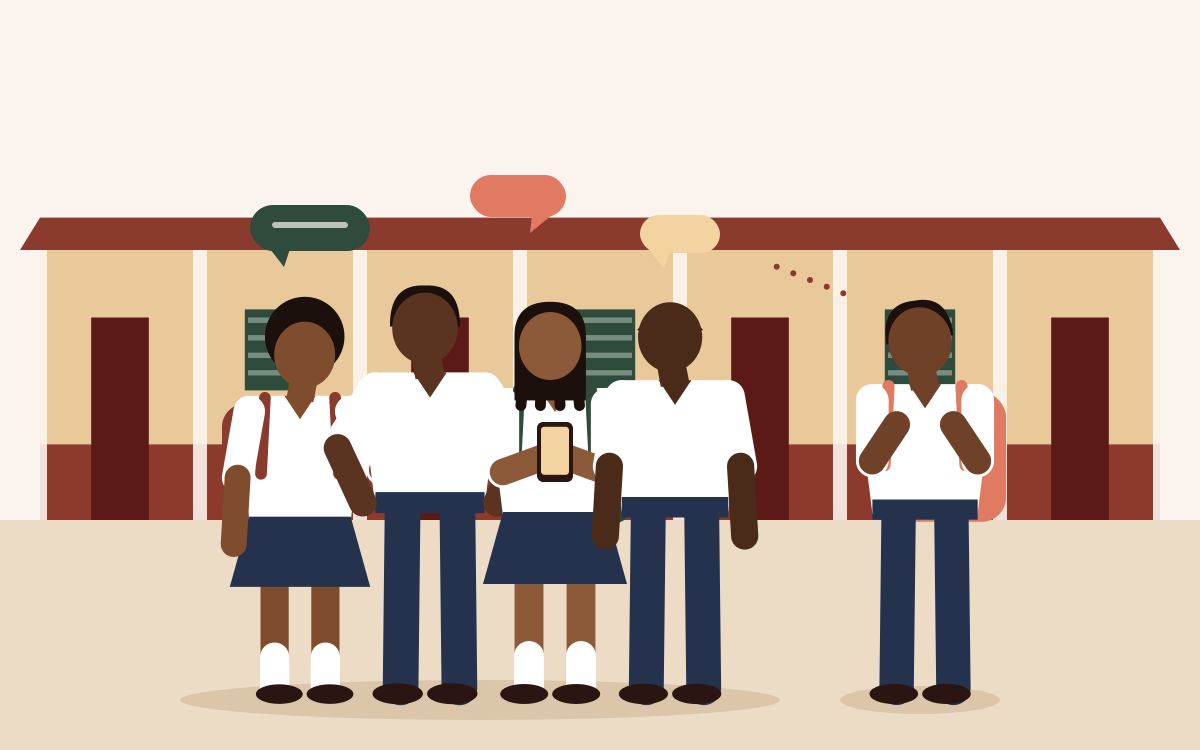
One common mistake should be avoided: talking about the influence of friends only as a danger. Research on peer influence shows that it can encourage negative behaviours, but also prosocial ones. The group serves as a reference point: it provides norms, expectations and models against which the young person compares themselves.
A teenager surrounded by classmates who value studying, sport, creativity or community involvement may be drawn towards those behaviours. Another, surrounded by friends who mock certain courses of study, certain ways of speaking or certain plans, may gradually change their own preferences. Influence is therefore not automatically bad. It all depends on where it leads, how the young person perceives it and their ability to step back.
Family: a reference point, a support and a source of pressure

Before friends, there is usually the family. Parents pass on values, expectations and a certain idea of success. They also have experience that the teenager does not yet have. Their influence is therefore normal. But not all forms of parental involvement have the same effects.
Julia Dietrich and Bärbel Kracke studied 359 German adolescents aged 15 to 18. They distinguish three parental behaviours regarding career choices: support, interference and lack of engagement. Parental support was positively associated with exploring career options. Conversely, interference and lack of engagement were associated with greater difficulties in decision-making.
The distinction matters. A parent who asks, “Have you looked at what this course requires?”, “What really interests you about it?” or “Would you like us to meet someone who works in this field?” is supporting exploration. That is not the same as imposing a profession, nor as withdrawing completely from the decision.
The parental role is therefore not just about saying yes or no. It is also about helping the young person broaden their information, compare options and put their own reasons into words.
School also shapes how young people see themselves
The school environment also plays a part in how choices are built. A mark, a teacher’s comment, a recurring difficulty or a word of encouragement can gradually change how a teenager perceives their own abilities.
“Science isn’t for me”
“I’m bad at speaking in front of others”
“I’m not cut out to lead”
A young person may end up telling themselves: “Science isn’t for me”, “I’m bad at speaking in front of others” or “I’m not cut out to lead”. But they may also discover at school that they enjoy explaining, creating, calculating, organising or solving problems.
In Bronfenbrenner’s ecological model, school is precisely one of the immediate environments that contribute to a young person’s development. In the Democratic Republic of the Congo, this responsibility is also recognised institutionally. The Ministry of National Education and New Citizenship defines school guidance as a process that should enable pupils to discover their aptitudes, interests and values in order to make informed educational choices. The Ministry also lists the development of pupils’ decision-making autonomy among its objectives.
The issue therefore goes beyond simply choosing a course of study. It is about learning to know oneself and to make decisions step by step.
Social media has added a new sphere of influence

Today’s generation is growing up with an environment that classic models of development obviously did not know in its current form: the digital space. Friends are no longer present only in the playground or the neighbourhood. They remain within reach on the phone. Celebrities, content creators and sometimes complete strangers also enter the teenager’s daily world.
In 2022, the HBSC survey coordinated by the World Health Organization Regional Office for Europe covered nearly 280,000 adolescents aged 11, 13 and 15 in 44 countries and regions across Europe, Central Asia and Canada. Thirty-six per cent reported being in almost constant contact with their friends online. Eleven per cent showed signs of problematic social media use. These figures do not describe Congolese youth and should not be transposed to the DRC; they do, however, give a measure of the place that digital interactions have taken in adolescent social life.
A systematic review published in 2025 by Hamide Avci, Laura Baams and Tina Kretschmer brought together 32 studies covering 19,658 adolescents. It concludes that, for identity development, what young people do on social media seems to matter more than the simple amount of time spent online. Social comparison, in particular, is associated with more identity exploration, but also with more identity distress.
Digital life is therefore not a uniform influence, positive or negative by nature. Above all, it provides an additional space for comparison, social validation, exposure to role models and identity experimentation.
And in the DRC, what do we actually know?
Scientific caution is essential. To our knowledge, the Democratic Republic of the Congo does not yet have a large national survey that would allow us to state that a given percentage of all Congolese adolescents are influenced by their friends or parents in their choices. Local studies nevertheless make it possible to observe certain mechanisms.
In Kamina, a study published in 2025 looked at the factors explaining why few boys choose the tailoring and dressmaking stream. Forty per cent of respondents cited the influence of friends among the demotivating factors, 28% the influence of parents and 20% embarrassment. In addition, 80% considered this stream to be reserved for women.
Kamina (2025): demotivating factors cited by respondents
These figures cannot be generalised to all adolescents in the DRC. They do show, however, how a social norm can close off an option before the young person has even considered their aptitudes, their interest or the career prospects of the stream. Here, the peer group, the family and a gender stereotype play a direct part in how a school option is perceived.
In Kasa-Vubu, in Kinshasa, a study published in 2026 among 80 parents found limited awareness of school guidance services. Most of the parents surveyed left the choice of stream to their child and had not consulted a guidance counsellor. This finding matters: letting a teenager decide is not necessarily the same as supporting them. A young person can be free to choose while lacking information, reference points or opportunities to explore other options.
Letting a teenager decide is not necessarily the same as supporting them.
What the research allows us to say
Taken together, these studies describe not so much a “manipulated” teenager as a teenager under construction, placed at the centre of several systems of influence.
Gardner and Steinberg showed that, in experimental conditions, the presence of peers could change adolescents’ risk-taking. Dietrich and Kracke showed that the way parents get involved matters: support is associated with more exploration, while interference and disengagement are associated with more decision-making difficulties. Recent research on social media shows that comparison, forms of self-presentation and the nature of online activity are linked to identity development. Finally, the Kamina and Kasa-Vubu studies offer a local glimpse of how friends, parents, stereotypes and limited access to guidance can enter into educational decisions.
In other words, several actors can influence the same choice, but not in the same way and not with the same effects. Peers can make certain behaviours more desirable because they bring recognition or belonging. Parents can broaden exploration or, on the contrary, narrow the choice when they impose a path. School can help pupils identify their abilities, but it can also trap a young person in a label if they are defined only by their marks. Social media can open access to new role models, while reinforcing social comparison and certain ideals of success.
The educational challenge
This is where the educational challenge lies: not asking teenagers to escape all influence, but teaching them to recognise who is acting on their decision, through what mechanism and with what possible consequences.
What this means for adults who support teenagers
For parents
Ask questions, present options, test assumptions against real information and explain their concerns without turning their preference into an imposed decision.
For schools
Start guidance before the final year, create opportunities for exploration, give access to professionals and help pupils put their interests, aptitudes and values into words.
For educators
Use the power of the group in a positive way. Since peers can influence one another, group activities can also promote analysis, curiosity, respect for others’ choices and seeking out information.
For digital education
Teach young people to recognise social comparison, staged success, hidden advertising and content that turns a trend into a norm.
For teenagers themselves
Learn a decision-making method: identify the influence, check the information, compare several options, anticipate the consequences and be able to explain the reasons for their choice.
- Identify the influence
- Check the information
- Compare several options
- Anticipate the consequences
- Explain your choice
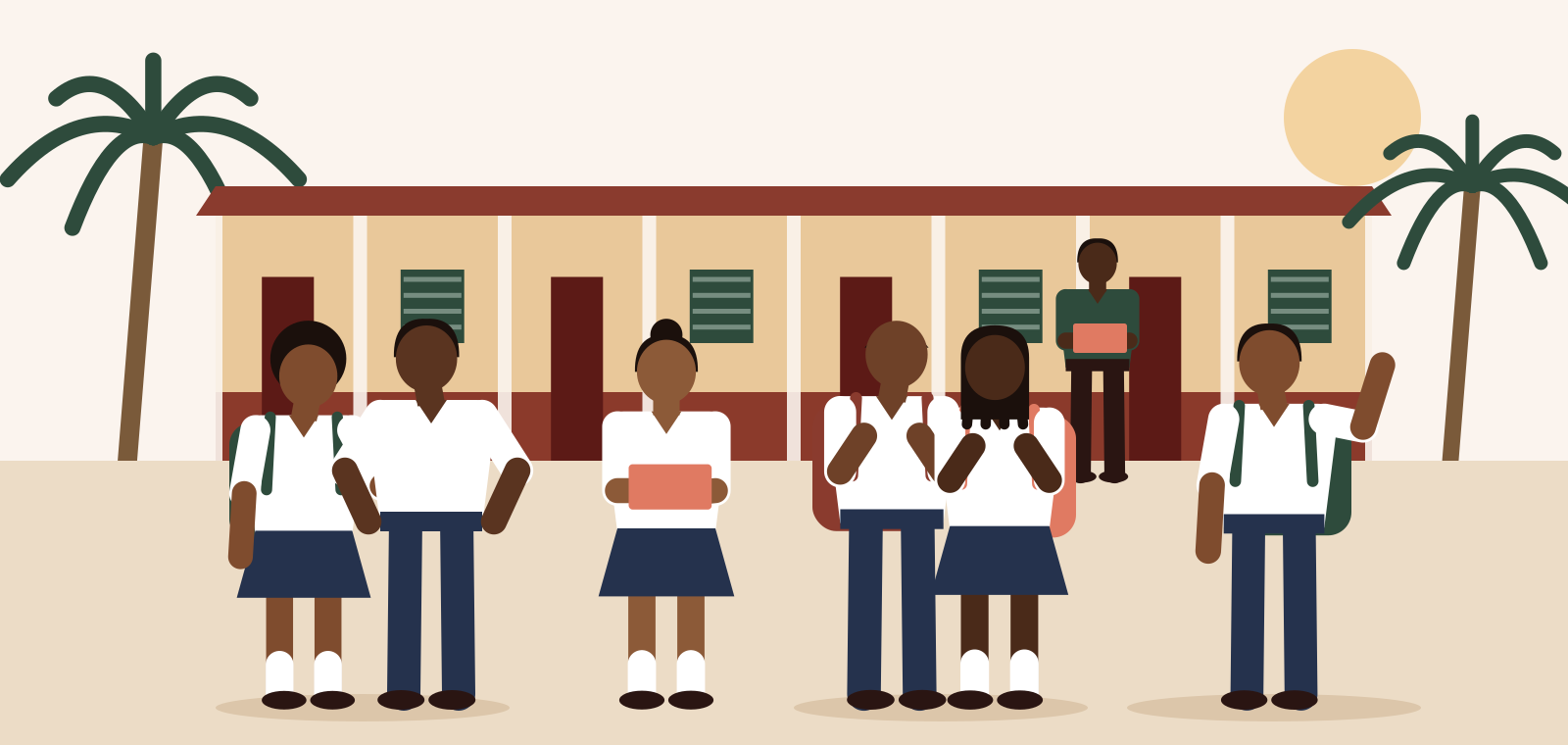
Making a choice is a process to be learned
The evidence presented here leads to a practical conclusion: the quality of a choice also depends on the quality of the environment in which it is built. A young person who is better supported, exposed to several possibilities and trained to question the influences around them is better placed to decide for themselves.
So the question to ask a teenager is not only: “What did you choose?” It should also become:
“Who weighed on this choice, what did you check, what other options did you consider, and why does this decision feel right for you?”
References and sources
- Albert, D., Chein, J. & Steinberg, L. (2013). Peer Influences on Adolescent Decision Making. Current Directions in Psychological Science, 22(2), 114-120. DOI: 10.1177/0963721412471347. View source
- Avci, H., Baams, L. & Kretschmer, T. (2025). A Systematic Review of Social Media Use and Adolescent Identity Development. Adolescent Research Review, 10, 219-236. DOI: 10.1007/s40894-024-00251-1. View source
- Bronfenbrenner, U. (1979). The Ecology of Human Development: Experiments by Nature and Design. Cambridge, Massachusetts: Harvard University Press. View source
- Dietrich, J. & Kracke, B. (2009). Career-specific parental behaviors in adolescents’ development. Journal of Vocational Behavior, 75(2), 109-119. DOI: 10.1016/j.jvb.2009.03.005. View source
- Gardner, M. & Steinberg, L. (2005). Peer Influence on Risk Taking, Risk Preference, and Risky Decision Making in Adolescence and Adulthood: An Experimental Study. Developmental Psychology, 41(4), 625-635. DOI: 10.1037/0012-1649.41.4.625. View source
- Kumwimba Kabongo, N., Matadi Alda, A., Mbuyu wa Ngoy, H. & Kasongo Mbayo, P. (2025). Étude de la démotivation du choix de la section coupe et couture par les garçons de la ville de Kamina (RD Congo) [A study of boys’ lack of motivation to choose the tailoring and dressmaking stream in the city of Kamina, DR Congo]. International Journal of Progressive Sciences and Technologies, 50(1), 366-372. View source
- Ngoya Mutela, B., Kokolomami Walo, A., Mayala Bangakula, M., Iyelinsa Yotuli, J. S. M. & Gbaka Ndaya, P. (2026). Perception et rôle des parents de la commune de Kasa-Vubu dans le processus de choix de filière d’étude de leurs enfants [Perceptions and role of parents in the Kasa-Vubu commune in their children’s choice of study stream]. Revue Internationale de la Recherche Scientifique et de l’Innovation, 4(4), 1674-1682. DOI: 10.5281/zenodo.21871250. View source
- World Health Organization - Regional Office for Europe (2024). Teens, screens and mental health. HBSC 2021/2022 data on social media use and digital gaming among adolescents. View source
- Ministry of National Education and New Citizenship - Democratic Republic of the Congo. Orientation scolaire [School guidance]. Official page on self-knowledge, aptitudes, interests, values and informed educational choices (in French). View source
Comments
Share your thoughts on this article. Your comment will be published after review by our team.